Reflections by Sarah Lavallée
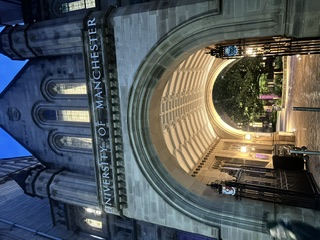
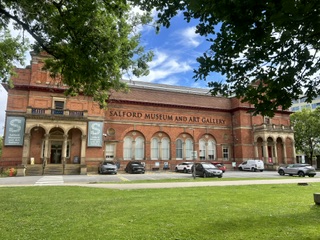
This week I attended the Sustainable Cities Conference in Manchester where I presented the main findings from my thesis. It was a really amazing opportunity to hear such diverse perspectives. Although the conference was relatively small (~100 attendees), it was amazingly international, with researchers from Iraq, Norway, Belgium, Taiwan, United States, and more!
I was reflecting on the train yesterday about my main takeaways from the conference, which I’ve typed up below:
1. Importance of considering the emotional experience of the city. A big theme throughout the conference, which consisted of a lot of urban planners and architects, was to consider how it actually feels to live, work, play, and move in the city. Several presenters emphasized that the success of a public design, or new urban space (e.g. greenspace, a bus stop, etc.) was in how it makes people feel while using it. Are they stressed while navigating public transit in the city, or is it a welcoming experience due to the cleanliness of the stations, lighting, lots of information, etc.? Although the design implications may be less relevant to us in SECC, it did get me thinking about the importance of considering how our research implications/interventions (e.g. new urban fishing infrastructure, more urban street trees, etc.) contribute to the emotional and sensory experience of local populations.
2. Potential friction points between accessibility/equity and conservation goals. One area of tension I noticed throughout the conference was how most approaches to increase accessibility are through the built environment (e.g. paved paths, more lighting, better transit, etc.), which often contradict approaches to re-wild the city in order to meet biodiversity and conservation goals. (Example: Increased lighting to make an urban park feel safer for local residents, but it increases light pollution for local bat populations and other organisms). While there are amazing initiatives that increase both sustainability and accessibility, I noticed that many researchers seemed to focus on one or the other, often influenced by local communities of interest and local government. It made me reflect on the challenge of meeting climate and sustainability goals while also ensuring that accessibility remains at the forefront.
3. Is it better to have imperfect solutions or to do nothing? This was a recurring question throughout the conference. Much like what Andrew wrote about in his reflection, there were also several discussions at the Sustainable Cities conference about how researchers are very good at identifying problems and explaining why they are problems, but are less good at proposing solutions. Even when solutions are proposed, researchers are trained to critique them, sometimes resulting in a lack of action. Is it better to accept that every solution will have flaws but implement them anyway, or do we continue refining solutions until we get one that is closer to perfect? I am still reflecting on situations where quick, albeit imperfect action may be required vs. other situations where more precision and time is required.
4. Working within the climate policy-action gap. Many researchers emphasized the need to make climate policy relatable to the average person and community. Many environmental policies fail because there is a disconnect between the policy’s goals and the values of everyday people (e.g. “I want a fast way to commute to work”, “I value local food but it needs to be affordable”, etc.). I think this is something that we already think about a lot, but it was an important reminder to find creative ways to make broad, conservation/environmental goals relatable to the local context. A good question someone asked is, “How do we add value to people’s lives through our sustainability work?”. I’m still thinking on that one. 🙂
5. Strong research can be simple research. I’ve realized that I often fall into the trap of thinking that academic research must be complex to be rigorous and/or valuable. I was struck by the simplicity and elegance of many of the research that was presented at the conference. Most research isn’t ground-breaking, but that doesn’t make it less valuable or important. In fact, I noticed that much of the research that appeared ‘less complex’ (not actually less complex, but it was more straight-forward and less conceptual) was also the research that was translated into action much more than the highly theoretical/conceptual research. And if action is your goal, then maybe simplicity should be embraced (I’m telling this to myself!).